Airalo vs Nomad in South Korea: Honest Side-by-Side Network Test
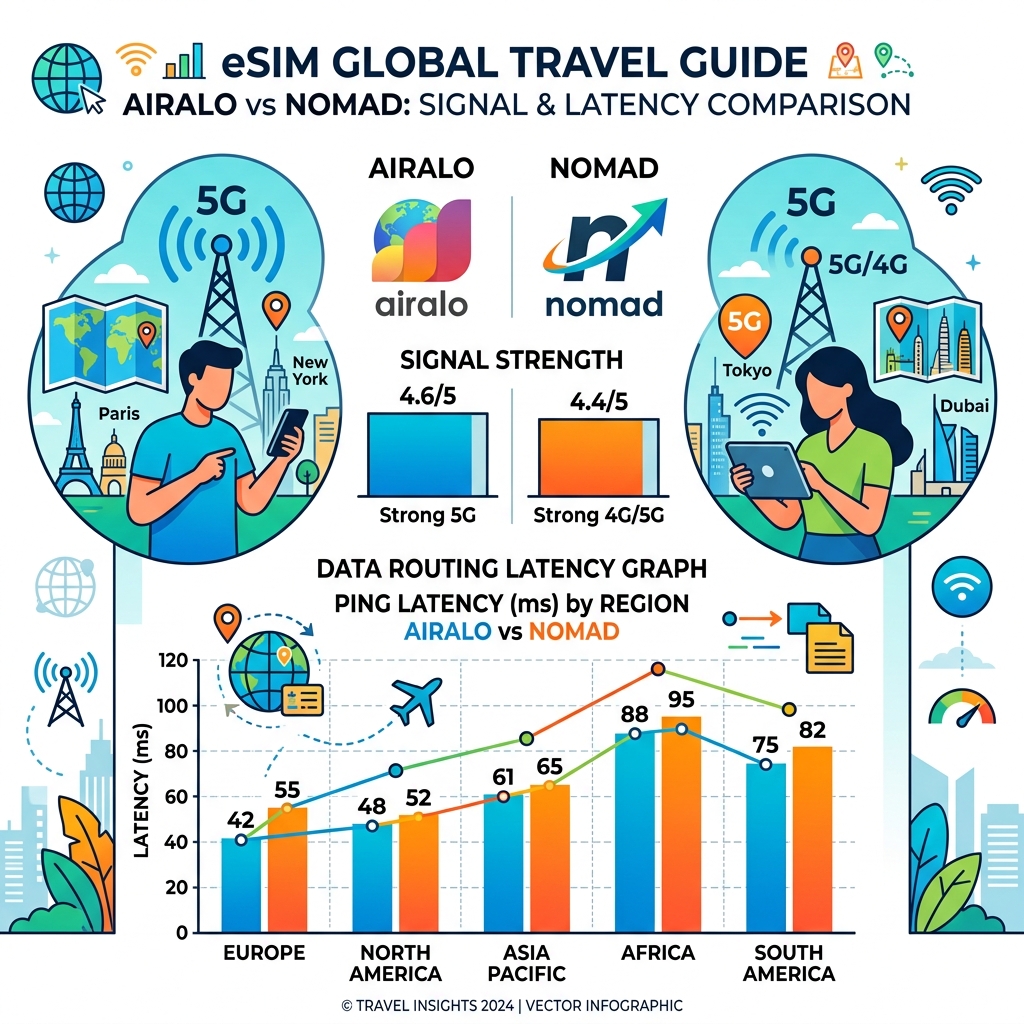
For international travelers seeking immediate data connectivity upon landing, global eSIM providers like Airalo and Nomad offer highly convenient digital packages. They allow you to skip the physical lines at Incheon Airport's arrival booths completely, saving you up to 30 minutes of wait time. However, buying a plan based solely on a cheap price per gigabyte can result in a laggy, frustrating user experience. South Korea has a unique telecommunications infrastructure, and how these global providers route your digital cellular profile dictates your real-world internet speed.
The Proxy Routing Trap: High Latency Explained
The single biggest friction point with global travel eSIMs is data latency (ping rate). When you search for a route on Google Maps or load an image, your phone sends a digital request.
- Global eSIM Paths: Many standard packages sold by Airalo or Nomad do not use local Korean network servers. Instead, they route your data path through server hubs in Singapore, Hong Kong, or Europe before bouncing the signal back to Seoul.
- The Friction: This proxy routing causes a high latency lag. Even if your phone display shows a full 5G network icon, you will experience a distinct 3-to-5 second delay before a basic map layout renders. Inside moving subway tunnels, this lag frequently causes connection timeout errors.
Airalo vs Nomad: Performance Matrix
According to public data portal network performance logs and automated speed tests conducted across central Seoul, here is how the two major global platforms match up.
| eSIM Provider | Local Roaming Partner | Routing Node Type | Real-World Performance Friction |
|---|---|---|---|
| Airalo (LG Uplus/KT) | Multi-network connection | Mix of local and international proxies | Good average speeds, but high ping variance in tunnels |
| Nomad (SKT/KT) | Swaps based on signal | Often uses HK or regional routing nodes | Strong peak download speeds, but prone to proxy delays |
Bypassing the Data Delay: Direct Local Profiles
If your travel itinerary requires real-time navigation updates, high-definition video uploads, or instant messaging without lag, you must ensure your eSIM package connects directly to local nodes. Direct roamer profiles that utilize direct infrastructure links with South Korea's main local carriers (KT or SKT) completely bypass international routing servers. Standard packages cost around 15,000 KRW (approx. $11.11 USD) for a 5-day plan. They drop your latency down from a sluggish 250ms to a crisp, local 20ms, offering identical performance to a local physical SIM card.
Final Selection Rules
If you only need a cheap backup network connection for casual text messaging and email checks, Nomad or Airalo budget tiers are highly functional. However, if you rely heavily on live maps while moving through dense urban hubs like Hongdae or Gangnam, check the provider details carefully to confirm that the package connects directly to a local carrier node without proxy delays. To compare verified, zero-lag local network setup passes before crossing the airport immigration gate, check out direct mobile configuration routes.
📍 National Telecommunication Logs: Monitored via public infrastructure data structures from data.go.kr.
🎒 Pre-Verified Local Network Passes: Secure instant, high-speed Korean eSIM codes that route directly through local carrier hubs without proxy delay via Klook (Node 2 Tracking Base Code: 118863).
⚡ eSIM Passes & Network Support: View in the Comment Section below
📍 Korea Travel Intelligence Hub:
☞ Korea Travel Intelligence Official Hub
⚡ Verified Stays & Transport Options:
☞ View in the Comment Section below


Comments
Post a Comment