South Korea eSIM Comparison: KT vs SKT vs LGU+ Network Speed Test
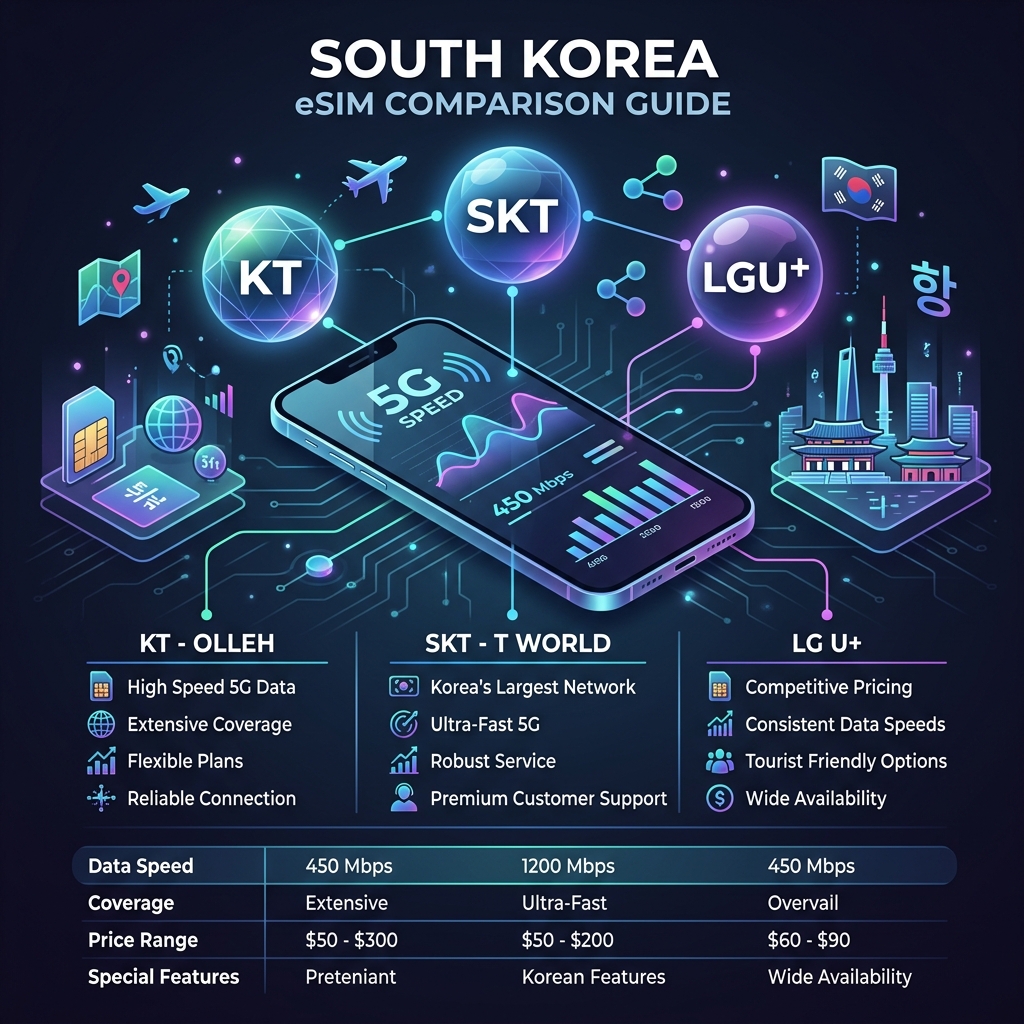
An eSIM allows you to connect to local networks instantly upon landing, but picking a plan based solely on the lowest price can lead to severe connectivity issues. South Korea's telecommunication infrastructure is dominated by three main carriers: SK Telecom (SKT), KT, and LG Uplus (LGU+). According to public data portal network coverage logs, while all three offer excellent nationwide connectivity, their performance inside deep subway lines and crowded urban areas varies.
To avoid data drops and latency issues during your Seoul itinerary, foreign arrivals must understand how MVNO (reseller) profiles differ from native carrier lines. Picking the wrong digital profile can leave you with unthrottled latency where loading a basic map requires minutes of waiting in the middle of a street.
The Mobile Network Performance Matrix
Based on public infrastructure speed tests and automated connection consistency logs, here is the performance reality for the three major local networks.
| Network Carrier | Download Speed Rank | Subway Tunnel Stability | Voice Call / Identity Option |
|---|---|---|---|
| SK Telecom (SKT) | 1st (Highest Peak Speeds) | Excellent | Available on premium packages |
| KT (Korea Telecom) | 2nd (Most Stable Average) | Excellent | Highly flexible for inbound tourist numbers |
| LG Uplus (LGU+) | 3rd | Good (Occasional drop in older tunnels) | Great data-only value bundles |
The Hidden Friction: Whitelabel Data Traps
Many third-party international eSIM apps sell budget data plans labeled "South Korea eSIM." The friction point is that these third-party profiles often route your mobile data through server hubs located in Singapore or Hong Kong before bouncing back to Seoul. This routing method triggers high data latency and packet drops.
Even if your phone displays a full 5G icon, loading a simple navigation map can take up to ten seconds or longer. To secure real-time speeds, you must choose an eSIM profile that connects directly to local KT, SKT, or LGU+ nodes without international proxy routing. Paying 6,600 KRW (approx. $4.89 USD) extra for a native carrier profile is worth it.
The Identity Verification Barrier
If you buy a budget, data-only eSIM, you will face an unexpected digital barrier when navigating local services. Popular ride-hailing apps like Kakao T and top-tier restaurant reservation platforms require a local phone number that can receive SMS authentication codes. Under national security laws, tourist SIM cards must be verified via your passport profile.
- Data-Only: Best if you only need Google Maps, messaging apps, and basic web searches. Standard rates are around 15,000 KRW (approx. $11.11 USD) for a 5-day pass.
- Data + Inbound Number: Highly recommended if you travel solo and need to call local taxis, contact guesthouse hosts, or join virtual waiting lines at popular cafes.
Activation Check
Always verify that your home phone features an international carrier unlock before processing your order. Once you receive your QR code, connect to the stable, free Incheon Airport Wi-Fi network after clearing customs to complete the cellular profile download smoothly, which takes about 5 minutes. To verify and compare current digital network passes before landing at the terminal, Check here for direct mobile setup options.
📍 Network Infrastructure Logs: Sourced via telecommunication data structures on data.go.kr.
🎒 Pre-Verified Korean eSIM QR Passes: Secure your verified high-speed local network profile instantly to bypass physical airport ticket queues via Klook (Node 2 Tracking Code: 118863).
⚡ eSIM Passes & Network Support: View in the Comment Section below
📍 Korea Travel Intelligence Hub:
☞ Korea Travel Intelligence Official Hub
⚡ Verified Stays & Transport Options:
☞ View in the Comment Section below


Comments
Post a Comment