WOWPASS Card vs Cash: The Break-Even Math for 5-Day Travelers
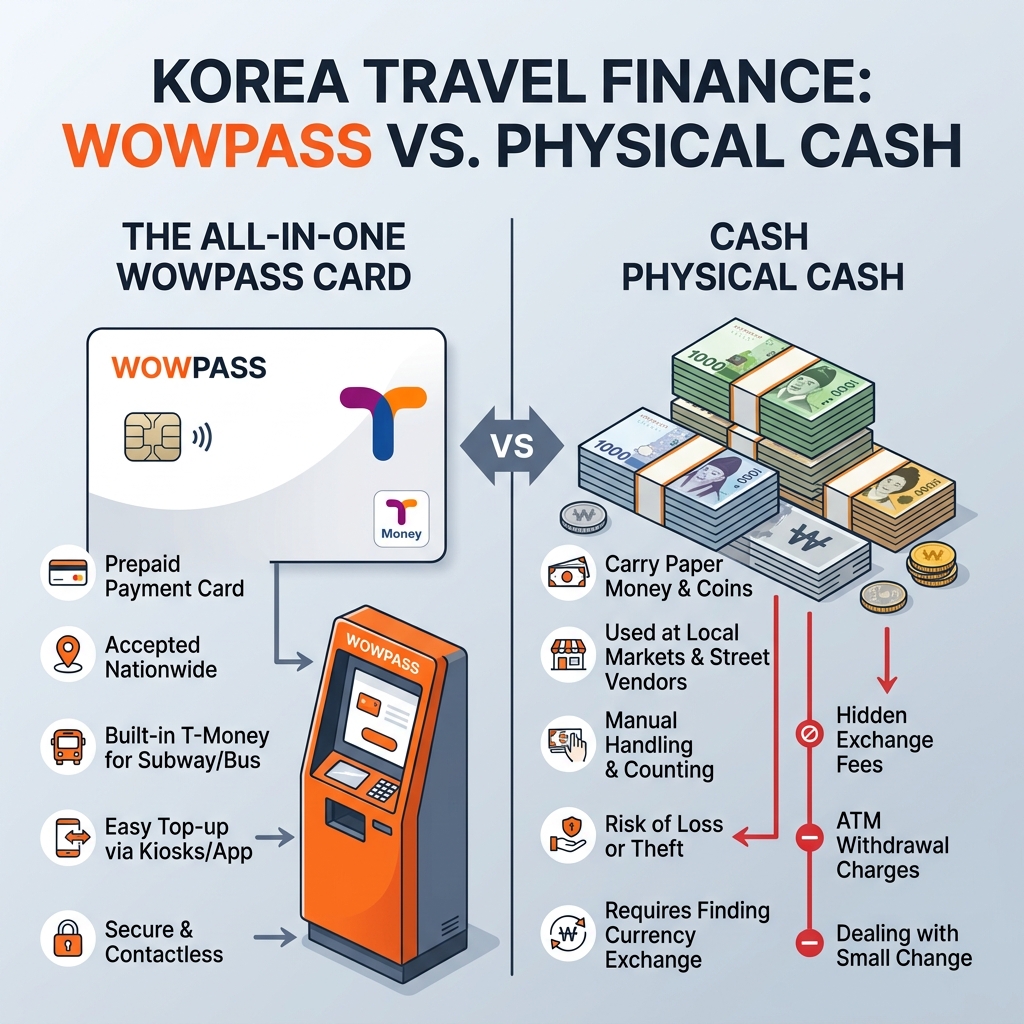
Navigating a highly digitalized city like Seoul requires a clear payment setup before you buy your first meal. Foreign tourists frequently debate whether to rely entirely on cold physical cash or purchase a dedicated tourist card like the WOWPASS.
To make a financially sound choice, you must look past the marketing promises and calculate the exact break-even point. Hidden issuance costs and transaction friction parameters can quickly drain your spending money if your itinerary does not justify the card setup.
The Financial Cost Breakdown
Based on current banking network logs and official card issuer fee structures, here is the raw cash flow comparison for a standard 5-day stay in South Korea.
- WOWPASS Card Issuance Fee: 5,000 KRW (Approximately $3.70 USD, non-refundable upfront cost).
- Standard Local ATM Cash Withdrawal Fee: 1,000 to 3,500 KRW per transaction depending on the local commercial bank network.
- WOWPASS Cash Out Fee: 1,000 KRW if you need to pull leftover physical cash out of the card at the end of your trip.
The WOWPASS card functions as a prepaid debit card that you can top up with your home currency (USD, EUR, SGD, etc.) directly at orange automated kiosks installed inside major subway stations like Hongdae or Myeongdong. It automatically converts your cash into local Korean Won at favorable exchange rates.
If you plan to perform multiple small cash exchanges throughout your trip, the financial math tilts heavily in favor of the card:
- The Cash Alternative Friction: If you arrive with zero Korean Won and perform three separate ATM cash withdrawals using your home debit card, you will accumulate up to 10,500 KRW (approx. $7.78 USD) in pure local network fees alone, completely wiping out any benefit of staying cash-only.
- The Break-Even Threshold: The initial 5,000 KRW (approx. $3.70 USD) card fee breaks even the moment you execute your second currency swap. Because the orange kiosks offer tighter exchange spreads compared to overpriced airport bank booths, you recover the upfront cost on your very first $150 USD exchange.
The Real-World Operational Friction
| Payment Method | Subway & Bus Utility | Card Kiosk Availability | Transaction Speed |
|---|---|---|---|
| WOWPASS Card | Built-in T-Money chip (Must be loaded with physical cash separately) | High inside Seoul subway stations, low in rural zones | Instant at all standard credit card terminals |
| Physical Cash | Zero acceptance on city buses, accepted at subway ticket stations | Requires physical currency exchange booths or bank counters | Slow, requires handling loose coin change |
The single most annoying friction point of the WOWPASS card is the transport chip separation. While the card pays for restaurants and retail items using your digital balance, the built-in T-Money transit feature runs on an entirely isolated circuit.
You cannot use your digital card balance to pay for subway rides. You must physically take paper cash out of your pocket and feed it into a subway station terminal machine to load the transport chip side of the card. A basic single ride costs 1,400 KRW (approx. $1.04 USD).
The Ultimate Decision Rule
If your 5-day itinerary focuses strictly on central Seoul and Busan where credit card terminals dominate every storefront, buying a WOWPASS saves massive time and keeps your wallet safe. However, if you are planning a short 48-hour transit stopover or intend to travel deep into rural countryside villages where orange kiosks do not exist, stick to small paper bills to avoid the unrecoverable card issuance fee. To secure your pre-verified digital transit vouchers or review alternative card access options before landing at the gate, Check here for direct configurations.
📍 Financial Fee Matrix Data: Monitored via exchange log structures from data.go.kr.
🎒 Pre-Verified Korean Transport Passes: Secure your entry data connections and regional transport passes smoothly to skip the airport station ticketing bottlenecks via Klook (Node 2 Tracking Code: 118863).
⚡ eSIM Passes & Network Support: View in the Comment Section below
📍 Korea Travel Intelligence Hub:
☞ Korea Travel Intelligence Official Hub
⚡ Verified Stays & Transport Options:
☞ View in the Comment Section below


Comments
Post a Comment