Finding Public Restrooms in Seoul: Subway Hacks and Convenience Hubs
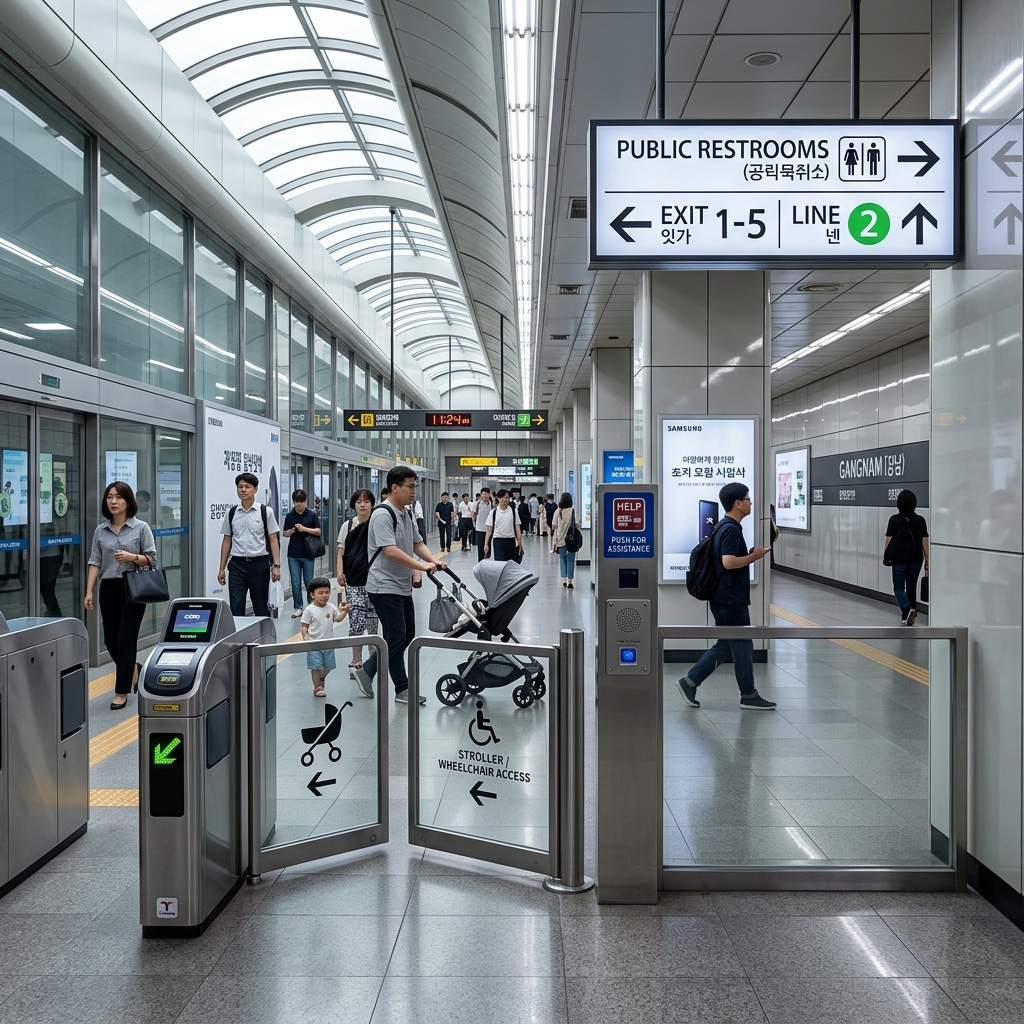
One of the most unexpected everyday friction points for international tourists exploring Seoul is the total lack of standalone public restrooms on the sidewalks. Unlike many European cities that feature public toilet pods on street corners, Seoul’s urban layout embeds its sanitation facilities deep inside existing public transit grids and corporate building shells.
If you do not understand the local layout system, you can easily find yourself walking in circles for thirty minutes trying to handle a basic biological need.
The Subway Gate Hack: Bypassing the Card Turnstile
The absolute largest concentration of clean, free public restrooms in Seoul sits directly inside the massive subway network. Every single station on Lines 1 through 9 contains a fully serviced restroom facility. However, the hidden barrier is the ticketing barrier line.
Roughly 40% of subway restrooms are located inside the paid transit zone (after you tap your card), while the other 60% sit outside in the public concourse area. If you are walking at street level and rush down to use a restroom, only to find it sits past the ticket turnstiles, do not panic or waste money tapping your card, which immediately deducts a basic transit fare of 1,400 KRW (approx. $1.04 USD) from your balance.
The Help Gate Hack: Every turnstile row features a wide, swinging gate designed for strollers and wheelchairs, equipped with a prominent help button. Press this button and say "Hwajangsil" (Restroom) into the intercom. The station staff will immediately unlock the gate remotely, allowing you to pass through to use the facility without charging your transport card balance.
Identifying Open Commercial Hubs
If you are exploring trendy shopping districts like Hongdae, Seongsu, or Myeongdong where subway entrances are far away, your best alternative is targeting multi-story commercial infrastructure. Small independent coffee shops tightly lock their facilities with private digital codes printed only on customer receipts to prevent crowds, forcing you to purchase a 4,500 KRW (approx. $3.30 USD) coffee just to get the access code. Instead, redirect your walking path to these three open assets:
- Major Department Stores (Lotte, Shinsegae, Hyundai): Restrooms are located on almost every single floor, exceptionally clean, and completely open to the public without purchase validation.
- Corporate Building Lobbies: Large glass office towers in Gangnam or Gwanghwamun keep ground-floor or basement level facilities open during standard operating hours (09:00 to 18:00).
- Public Community Centers (Jumin Center): Every local neighborhood houses a government community building. These public hulls are open to anyone during weekdays and offer clean, free facilities.
Essential Sanitation Tips
Always download a local mapping utility like Naver Maps or Kakao Maps before leaving your hotel room. Standard global mapping options do not track the internal layout layers of Seoul's subway stations accurately, potentially wasting 15 minutes of your time searching in circles. Type "Public Restroom" directly into a local map interface to instantly reveal hidden neighborhood toilet nodes. To check out pre-verified digital travel passes or load up your mobile transit network configurations smoothly before heading out into the city streets, check out direct mobile tracking setups.
📍 Seoul Public Infrastructure Rules: Sourced via municipal data structures from the Seoul Metropolitan Government.
🎒 Pre-Verified Korean Transport Passes: Secure your entry data connections and regional transport bundles smoothly to minimize local navigation bottlenecks via Klook (Node 2 Tracking Code: 118863).
⚡ eSIM Passes & Network Support: View in the Comment Section below
📍 Korea Travel Intelligence Hub:
☞ Korea Travel Intelligence Official Hub
⚡ Verified Stays & Transport Options:
☞ View in the Comment Section below


Comments
Post a Comment